🤖 AI Integration
PROMPT reaches language models through one service, the AI server (servers/ai). It is the only
component that talks to the model provider, Logos. Phase servers call it with their service key, the
user's Keycloak token and their own Logos key for the course phase, and it records every call in its own database
before the provider sees it. Its audit records are browsed in their own micro-frontend,
clients/ai_component.
Everything AI is behind one switch, AI_ENABLED, which is off by default.
Do not set AI_ENABLED=true in production before #2290 is resolved. Switching AI off again stops
the AI server and its database, and core leaves the AI module out of its privacy fan-outs, so the
stored records are no longer purged, exported or erased.
Component Diagram
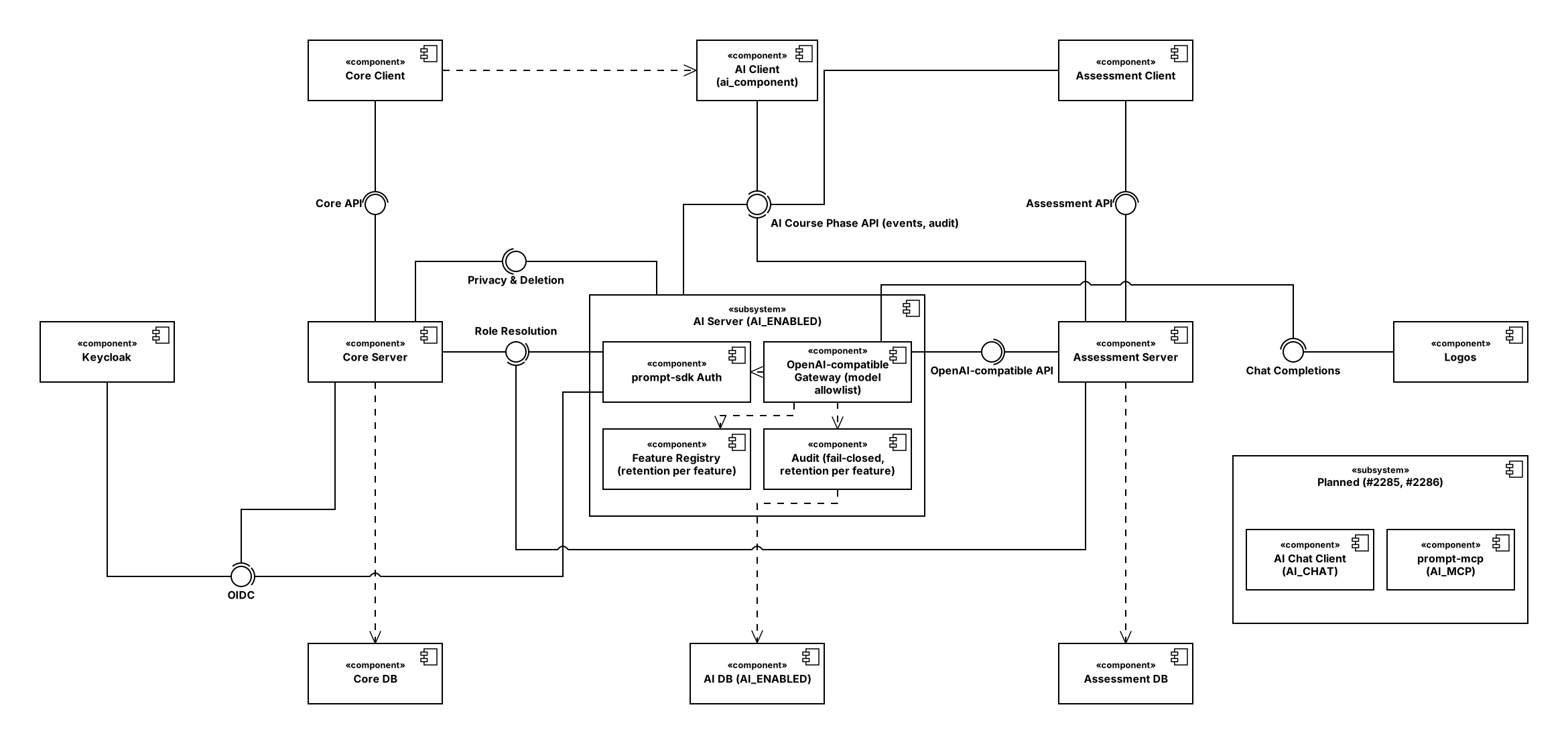
The AI server, its database and the AI client run only with
AI_ENABLED=true. The Assessment client and server stand for any phase that uses AI. The planned components are tracked in #2285 (prompt-mcp) and #2286 (AI chat). The diagram is an Apollon model: importimg/ai-integration/ai-integration.jsonthere to edit it, then export JSON and SVG again.
Decision Records
- Packaging. A separate service,
servers/ai, with its own PostgreSQL database. Core stays out of the model call path, so a slow or stuck model call cannot starve it. The audit UI is a module-federated remote of its own,clients/ai_component, and not part of core: it ships and is switched off together with the AI server. - Exposure and auth. The AI server is public under
/ai/api/course_phase/:coursePhaseIDand uses the unchanged prompt-sdkAuthenticationMiddleware(Keycloak JWKS plus core role resolution). The course phase id is part of the URL, the one place the middleware reads it from: an OpenAI-compatible body takes no extra fields. The inference routes also need a phase service key (X-Prompt-ServiceandX-Prompt-Service-Token, checked againstAI_SERVICE_KEYSwith prompt-sdkserviceAuth, the check core's audit ingest uses), so a staff token copied from the browser cannot call the model or put made-up content into a student's record. The calling service is recorded with each call. Inference and events: PromptAdmin, CourseLecturer, CourseEditor. Audit reads: PromptAdmin. No students, and neverPromptLecturer, which the SDK lets pass for every phase (#2288). - Contract. OpenAI-compatible pass-through:
POST /v1/chat/completionsandGET /v1/modelsunder the course phase path. PROMPT context goes into headers:X-Prompt-Service,X-Prompt-Service-Token,X-Prompt-Provider-KeyandX-Prompt-Featureare required,X-Prompt-Template,X-Prompt-Template-VersionandX-Prompt-Subjectsoptional. The response carriesX-Prompt-AI-Call-ID. Prompt templates, context aggregation and identifier stripping stay in the calling service. - Model access. Logos only. Each phase server keeps its own Logos key per course phase and
sends it in
X-Prompt-Provider-Key; the AI server stores no keys. So every course can use a different key. The AI server is no freely usable endpoint: only phase services holding a service key reach the inference routes, and a call without a phase's Logos key never reaches Logos. Assessment is the pilot for a phase-owned key (#2291); a shared key for configuration tasks is #2289.AI_ALLOWED_MODELSrestricts requests to models Logos hosts locally, because a Logos key alone does not guarantee local processing. No rate limiting or budget logic in the AI server: Logos meters per key. - Streaming. OpenAI SSE end to end, passed through rather than re-encoded
(
httputil.ReverseProxy). Clients usefetchpluseventsource-parser, becauseEventSourcecannot send a bearer token. Calls stay inside the user's request; there is no background execution. - Audit. Own database, fail-closed: the record is written before the provider is called.
Every call names its feature, which sets the content retention from a feature registry in code
(
<phase type slug>.<feature>, prefix enforced against the phase's type, which the AI server asks core for once per phase, and against the service whose key made the call). A call without a registered feature is refused, so there is no call without a retention. Each record keeps the caller and their role, theissclaim of the token, the requested and served model and the provider's system fingerprint where it reports one. Metadata retention is longer than the longest content retention. Nothing goes to core'saudit_log, and phase servers mark their AI routes withaudit.Skip(). - Human oversight. Events API for
shown,accepted,edited(edit distance) andrejected, reported by the user who made the call. Audit reads are admin-only, under the course phase routes, and every content read is itself recorded. The admin page per course lives in theai_componentmicro-frontend, which lists the calls one phase at a time. - Privacy. Core asks the AI server as a standalone module (
servers/core/standaloneModule, a service that is not a phase type but keeps data per person) in the privacy export and per-student deletion fan-outs when AI is enabled. It keeps no data per course phase, so phase deletion does not ask it. High-risk content under erasure is access-restricted until its retention ends (GDPR Art. 17(3)(b)); other content is deleted immediately. Students are informed through the privacy policy (AI Act Art. 26(11)); lecturer-facing output is labeled AI-generated (Art. 50(1)). - Switch and failure behavior. One GitHub variable,
AI_ENABLED, off by default. The deployment derives the compose profileaifrom it (AI server, its database and the AI client), and it is passed to core and to the phase servers that use AI. Core loads the AI remote only while the AI server answers healthy on/ai/api/info. Disabled, unreachable or unconfigured all mean the AI surfaces are hidden and the workflow is untouched. The chat and MCP components get switches of their own,AI_CHATandAI_MCP, on top ofAI_ENABLED, so no dead AI functionality ships. - Regulatory stance. Treated as high-risk under the EU AI Act (Annex III 3(b), steering the learning process; the Art. 6(3) exemption does not apply because condensing feedback about one student is profiling). Logging per Art. 12, retention of at least six months per Art. 19 and 26(6) for high-risk features. The high-risk obligations apply from 2 December 2027.
- Testing. aimock (
ghcr.io/copilotkit/aimock) as the stub provider in the Go tests (testcontainers) and in theaie2e shard, with shared fixtures undere2e/fixtures/aimock. - Evaluation study data. The study gets only an anonymized aggregate (counts, acceptance and edit-distance distributions, latency per feature and template version), produced by a documented SQL script run by an admin. Raw audit data never leaves production.
Calling the AI Server
A stock OpenAI SDK works against the AI server: set baseURL to
<host>/ai/api/course_phase/<coursePhaseID>/v1, pass the user's Keycloak token as the API key and
the service's name and key, the phase's Logos key and the feature as default headers
(X-Prompt-Service, X-Prompt-Service-Token, X-Prompt-Provider-Key, X-Prompt-Feature). The
service key is the phase server's entry in AI_SERVICE_KEYS; it never goes to the browser.
| Route | Roles | Purpose |
|---|---|---|
POST /v1/chat/completions | Phase service key, then PromptAdmin, CourseLecturer, CourseEditor | Streamed or plain completion |
GET /v1/models | Phase service key, then PromptAdmin, CourseLecturer, CourseEditor | Models both allowed and available to the key sent along |
POST /calls/:callID/events | Phase service key, then PromptAdmin, CourseLecturer, CourseEditor | Oversight events, on the caller's own calls made by the same service (any call of that service for PromptAdmin) |
GET /calls, GET /calls/:callID | PromptAdmin | Audit metadata, and one call's content |
The gateway forwards the body unchanged, except that the model must be in AI_ALLOWED_MODELS,
user is removed so no identifier reaches the provider, and streams always end with a usage
chunk. Only the phase's key goes to the provider, never the caller's token or the X-Prompt-*
headers. A call without a service key answers 401 and is not recorded. A call without a Logos key,
without a registered feature of the phase's type and the calling service, or with a feature, template or template version
that is not a label of letters, digits, ., _ and - of at most 128 characters answers 400
and is recorded as denied, without the refused label. If the call cannot be recorded, the
answer is 503 and the provider is never called. Requests over 4 MiB are refused (2 MiB on every
other route); a call ends after 10 minutes, and a streamed call also after 2 minutes without a
chunk.
Oversight events need the service key like inference: the phase server knows what its UI showed,
accepted, edited or rejected, and reports it with the staff member's token. A token alone cannot
write oversight evidence, and an event is only accepted with the key of the service that made the
call, so another phase's key gets the same 404 as another phase's id.
X-Prompt-Subjects takes at most 100 course participation ids. They are recorded as given, so the
calling service is responsible for naming the right students.
A feature is named <phase type slug>.<feature>, for example assessment.action_item_suggestions.
The slug is the phase type name in kebab case. A new feature, or a different retention, is a change
to servers/ai/feature/registry.go.
| Feature | Content retention | High-risk |
|---|---|---|
assessment.* | 730 days | yes |
Audit Records
| Table | Contents | Retention |
|---|---|---|
ai_call | Who (Keycloak sub and role, no name), the token's issuer, the calling service, phase, feature, template, requested and served model, system fingerprint, parameters, outcome, status, finish reason, tokens, timings | AI_AUDIT_METADATA_RETENTION_DAYS (default 1825) |
ai_call_content | Request and response as passed through, AES-GCM encrypted with a key version byte and bound to the call id; a cancelled stream keeps its partial response | per feature |
ai_call_subject | The course participations named in X-Prompt-Subjects | per feature |
ai_call_content_restriction | Content kept but restricted after an erasure request | per feature |
ai_call_event | shown, accepted, edited, rejected, content_viewed | metadata retention |
Triggers keep the audit tables append-only: the only update completes a pending call once. A daily purge, which also runs at startup, deletes content and subjects per feature and then metadata, and closes calls left pending by a restart. The AI server refuses to start unless the metadata retention is longer than the longest content retention.
Privacy
- Export: the calls a person made, and the calls they were a subject of, with their events and the answer of every choice (content, refusal and tool calls). Content is included only while it is retained and not restricted, and only to the call's sole subject: content that also concerns other people is withheld (GDPR Art. 15(4)). The other party's identity is left out.
- Erasure: applies to the calls the person was a subject of. High-risk content is restricted until its retention ends, other content and the person's subject link are deleted at once. The metadata of calls the person made stays as logging evidence.
- Phase and course deletion: nothing to delete in the AI server; the audit records stay until their retention ends. The phase server deletes its key with the phase.
Core asks the AI server like a phase module in the privacy fan-outs: if it is unreachable, the privacy request reports the AI part as failed.
Configuration
| Variable | Purpose |
|---|---|
AI_ENABLED | The switch. The Makefile and the deployment derive COMPOSE_PROFILES=ai from it |
AI_PROVIDER_BASE_URL | OpenAI-compatible base URL of Logos, including /v1 |
AI_ALLOWED_MODELS | Comma-separated models Logos hosts locally |
AI_ENCRYPTION_KEYS | Keys for the stored content as 1:<key>,2:<key>, each openssl rand -base64 32. New content uses the highest version |
AI_AUDIT_METADATA_RETENTION_DAYS | Call metadata retention in days |
AI_SERVICE_KEYS | Phase services allowed to call the model, service1:key1,service2:key2 like AUDIT_INGEST_KEYS |
AI_HOST | Where the core client and the AI client reach the AI server; the core host in production |
DB_HOST_AI, DB_PORT_AI | The service's own database (local default port 5442) |
Provision AI_SERVICE_KEYS like the audit ingest keys: one key per calling service, each generated
with openssl rand -hex 32 and never the same as that service's audit ingest key. The service name
is the slug its features start with (assessment), so a key only reaches its own phase type. To
rotate a key, list the new one next to the old one, switch the service over, then drop the old one.
To rotate the content key, add a new version to AI_ENCRYPTION_KEYS (for example 1:<old>,2:<new>)
and redeploy. Every ciphertext starts with its key version, so new content is sealed with version 2
and older rows still open with version 1. Keep a version listed until the retention purge has
removed every row sealed with it; content whose version is missing shows as unavailable.
In production Traefik routes /ai/api to the AI server with the API rate limit and without the
compress middleware, which would buffer streamed completions, and /ai to the AI client. Locally,
set AI_ENABLED=true, AI_ALLOWED_MODELS and an AI_SERVICE_KEYS entry for every calling phase
in .env (without one, every inference call answers 401): make db then starts the AI database,
make server-ai the server on port 8092 and make client-ai the AI client on port 3013. The e2e
shard ai runs the stack with the AI server, the AI client and aimock as the provider.
Open Items
- A data protection impact assessment (GDPR Art. 35).
- With the data protection officer (#2290): what happens to AI data while
AI_ENABLED=false(the database is stopped, so no purge, export or erasure reaches it); how GDPR erasure weighs against the AI Act's logging duties; restricting instead of deleting high-risk content during its retention; a pseudonymized study export, only if the aggregate is not enough. - Follow-ups: prompt-mcp (#2285), the AI chat (#2286), a shared key for configuration tasks (#2289), the role model and per-request role lookups (#2288), and the assessment key pilot (#2291).